
Informasjon
The ORACLE.
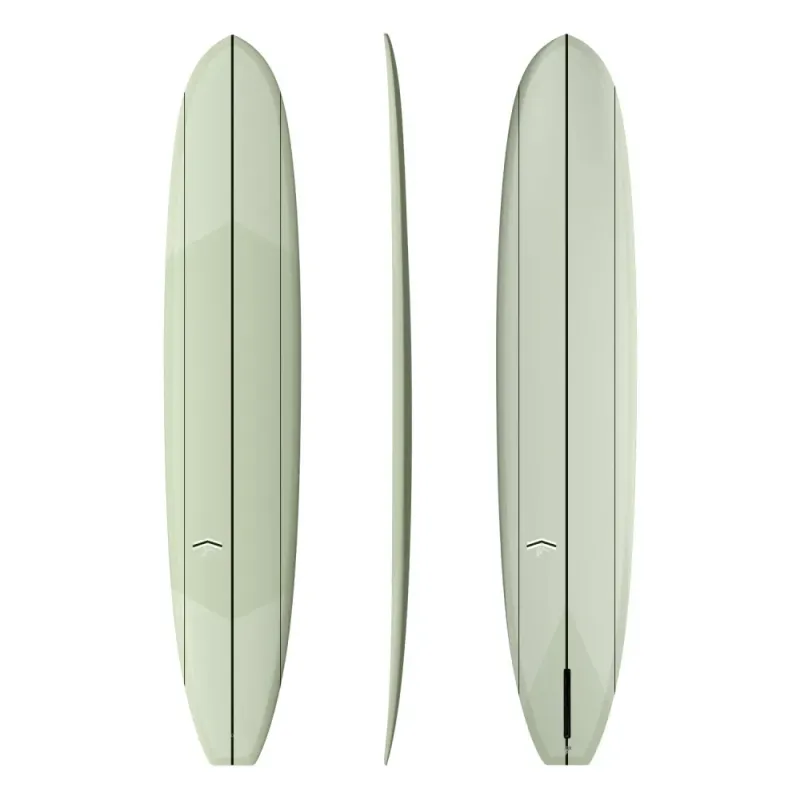
In 2016, Thomas Campbell lent CJ his Skip Frye Eagle to help him get through the Santa Cruz summer. At the time, CJ’s glider experience was minimal, aside from riding his father's 10’3” Phil Edwards Waikiki. The speed and glide of the Eagle changed his outlook on what longboards could and should feel like. He was hooked on the flow, but envisioned a glider that could also noseride, pivot, and slash—turning a novelty board into a daily driver.
The Oracle is the culmination of years of glider experimentation. We transformed a point-and-shoot glider into a well-rounded, performance-driven longboard. Most gliders are notoriously difficult to maneuver, but the Oracle breaks that mold. It features generous rocker to reduce hangups, performance rails, a concave nose, tail flip for noseriding, and a lightweight glass job for enhanced responsiveness. If you want to surf well into your 80s, this is the board to master. A must-have for every surfer.
(Concept designed by CJ x Ryan Engle)
| 10'6" | Volan | Silver | 24" | 3.38" | 92.5L | FCS10" | Matte |
Vi anbefaler
Flying Diamonds - Kai Sallas X Kani Stewart 10.0" Waikiki Blue
Produsent
Thunderbolt Surf
Thunderbolt Technologies
Thunderbolt Technology utilizes advanced materials and technology to decrease weight while enhancing performance, flex characteristics, board control, and durability. Mass-produced epoxy boards are corky and stiff. While light and durable, they simply don’t ride well. But Thunderbolt’s hand-built boards take superior epoxy materials to an entirely different level. These boards provide the feel and sensitivity of a good poly board, but deliver performance far beyond traditional epoxy pop-out constructions. Indeed, those who ride these high-tech epoxy boards claim they actually feel better than polyurethane.
Thunderbolt boards are 100% hand layups. They begin with an EPS foam core with multi-component carbon fiber stringer systems that produce engineered flex and twist for a more lively, responsive performance. Proprietary designs employing internal carbon fiber components are then arrayed in the deck and bottom of the deck for precise flex control and strength.
The core shield PVC provides flexible protection to increase strength and durability without compromising the flex and twist characteristics built into the blank. With ample carbon fiber and fiberglass in the deck, bottom, and rails, these boards both outperform and outlast traditional PU boards and other epoxy designs.
